Total Pageviews

Monday, 5 March 2018

Dr Fastus movie review


Dr. Faustus :A Play by Christopher   Marlowe


(1). In the last scene of the play we can see that Lucifer's image signify that bad win against the good and Dr Faustus is not believe in God and end of the play finally he die that's why it also signifies that devil wins against god.

(2). Yes, God is present in this play and Old man try to convince because God is not present to physically.We also find God from of Good Angel .

(3). The picture shows the myth of Icarus in which father Daedalus make wings to fly for him and his son Icarus told him that don't fly near to sun nigher your wings will burn and you will fall down but than even Icarus fly too much high and go near sun and his wings were melting and he fall down .

'Hamlet' Movie Screening


http://dilipbarad.blogspot.in/2013/08/worksheet-hamlet-movie-screening.html


Screening Movie: Kenneth Branagh’s ‘Hamlet’. Based on William Shakespeare’s ‘Hamlet’


1 Yes , "Hamlet" movie is totally faithful to original play The dialogue plot and story are totally same in this movie and Kennath branagh follows every scene very well.

2 After watching the movie my perception about is ophelia because his role is a very minor .

3 Yes , i feel aesthetic delight , when i watched this movie in the scene when Hamlet talk with her father's ghost when this scene came at that time i feel aesthetic delight.

4 Yes , i feel catharsis while watching movie when Hamlet's behavior with Opheliya cry on death of her father and thats why opheliya became mad .

5 Yes movie is very helpfull for me and give better understanding . My many confusions got clear when watched this movie and we can easiliy understand every dialogue and scene .

6 Ophelia's madness and grave digging scene was really very good and Hamlet says fist time that i loved ophelia this movment is a very cherish lifetime .

7 If i director i wouid like to change last scene of the play and i wouid like to creat happy ending and never kill ophelia .

8 Symbolism is one of the narrative technique Kenneth Brenagh has vry well used this teqnique in this movie because starting and ending both are very important of every movie and second symbol is rules made and broken as time change this is symbol also .

9 During studing the play and waching the movie i found two approch
1 The philosophical approch
2 The feminist approch
we can see that hamlet is a student o philosopy and her philosophical naturea and his intellectuallity
And feminist approch is can be possibal in ophelia's charecterand dor is a very significance their and thats why ophelia feel like a cage means women have not freedom and obay on her brother and father .

10 i just thought that "The feminist approch "is more applicable in this movie because in this play ophelia is victimof dominated society she used as a lead puppet .

From the Amoretti


    From the Amoretii :-  Edmund Spenser 


"From the Amoretti " is written by Edmund Spenser who was an English poet and was known for his well written poem ' Fairy Queen ' This sonnet was written in 16 th century which included 89 sonnet .

 In the first few lines the poet talks about the afforts that he took to mortilise name of his beloved . 

One fine day  he started writing his beloved's name upon the strand but waves became his enemy as it washed away his beloved's name .

 Still after the first failure he did not gave up and again try to write her name but once again the tide came and washed it away , this pain has very well expressed in the line by the poet is 

 "  But came the tide
    and made my pains his prey " 

 In next lines the poet talks about efforts to mortal name of his beloved. His beloved may be is watching him from somewhere at expresses her sorrow all her lovers failure.

 The poet there expresses his feelings because he is scared now as the way nature wiped out his beloved's name . His fear is that his name also can be 
' Wiped out likewise  " . 

 In the las few lines of the poem , poet expresses his fear and he still will continue to etrnize the name of his beloved he console his beloved by saying that she may " Die in dust " but she will live by fame . She would be in the memory by her virtues and she would live in verses even after death when death will subdue entire world there love shall live this how the poet describes the unstoppable efforts of a lover to mortise the name of his beloved .   

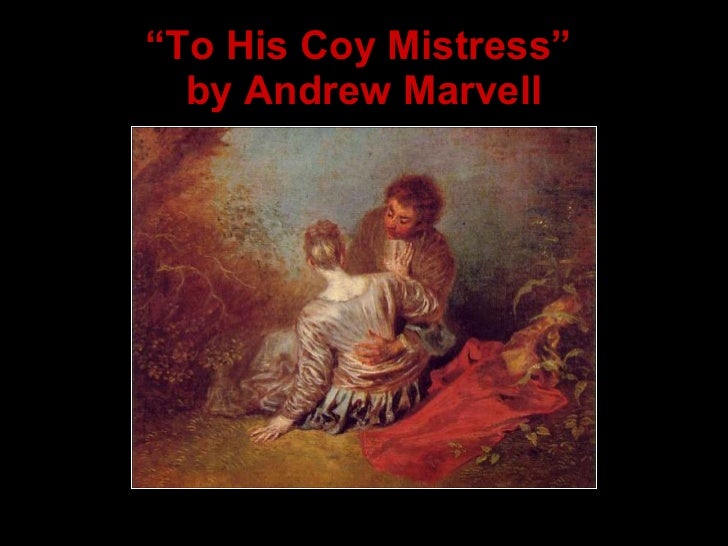
To His Coy mistress


To His Coy Mistress :- Andrew Marvell


                           Poem

     Had we but world enough, and time,
     This coyness, Lady, were no crime.
     We would sit down and think which way
     To walk and pass our long love’s day.
     Thou by the Indian Ganges’ side
     Shouldst rubies find: I by the tide
     Of Humber would complain. I would
     Love you ten years before the Flood,
     And you should, if you please, refuse
     Till the conversion of the Jews.
     My vegetable love should grow
     Vaster than empires, and more slow;
     An hundred years should go to praise
     Thine eyes and on thy forehead gaze;
     Two hundred to adore each breast;
     But thirty thousand to the rest;
     An age at least to every part,
     And the last age should show your heart;
     For, Lady, you deserve this state,
     Nor would I love at lower rate.
     But at my back I always hear
     Time’s wingèd chariot hurrying near;
     And yonder all before us lie
     Deserts of vast eternity.
     Thy beauty shall no more be found,
     Nor, in thy marble vault, shall sound
     My echoing song: then worms shall try
     That long preserved virginity,
     And your quaint honour turn to dust,
     And into ashes all my lust:
     The grave’s a fine and private place,
     But none, I think, do there embrace.
     Now therefore, while the youthful hue
     Sits on thy skin like morning dew,
     And while thy willing soul transpires
     At every pore with instant fires,
     Now let us sport us while we may,
     And now, like amorous birds of prey,
     Rather at once our time devour
     Than languish in his slow-chapt power.
     Let us roll all our strength and all
     Our sweetness up into one ball,
     And tear our pleasures with rough strife
     Thorough the iron gates of life:
     Thus, though we cannot make our sun
     Stand still, yet we will make him run.


The poem "To His Coy Mistress" is written by 
Andrew Maewell who was the son of a Clergyman 
he was a metaphysical poet and his most of poem 
focus more on "love" and "God" . This poem 
is also about "love" and shyness of the beloved.
 
The poet starts with the coyness of beloved say-
ing that if both the lover ,had enough time then 
beloved's coyness was no crime but hence beloved 
is so shy that is like a crime her shyness has
become a crime because they have very less time 
left and if they could think over how to pass 
their " long love's day " .

In the few lines poet talks about "Indian Ganga"
"Huber" and comparing his love to vegetable that 
his love like vegetable which grow day by day 
then poet praising each parts of beloved's body 
 
Then poet says that if beloved shall continue her
coyness then one day when the death will arive her 
beauty will be no more as well as the echoing 
song also want be thre once she is dead.The 
beloved is very coy and therefor she is not allo-
wing the lover came close to her and therefore 
the poet says once she dead .
 
Then the poet compares with "youth " with 
"Mourning due" . And the last lines the poet 
usage two lines in the end of the poem that are
 
 
     "Thus through we cannot make our 
    sun stand, yet we will make him run ." 


Ode on Solitude


        Ode on Solitude :- Alexander Pope


Poem


Happy the man, whose wish and care
A few paternal acres bound,
Content to breathe his native air,
In his own ground.

Whose heards with milk, whose fields with bread,
Whose flocks supply him with attire,
Whose trees in summer yield him shade,
In winter fire.

Blest! who can unconcern'dly find
Hours, days, and years slide soft away,
In health of body, peace of mind,
Quiet by day,

Sound sleep by night; study and ease
Together mix'd; sweet recreation,
And innocence, which most does please,
With meditation.

Thus let me live, unseen, unknown;
Thus unlamented let me dye;
Steal from the world, and not a stone
Tell where I lye. 


Summery 


"Ode om Solitude" is written by Alexander pope . Initially in the poem , the poet talks about lonely life of a farmer we think that the life of the farmer is unfortunate because he has to live in the farm away from the society but the poet considered the life of the society but the poet considered the life of the farmer a fortune one because farmer get the change to breath his '' native air '' and he also get the opportunity to live in motherland.


The poet again emphasis on how lucky the farmer are in the second stanza. the poet says that farmers get to out broad from his owe field and ''looks supply the farmer disattire .'' and during the summer if the sunlight annoys the farmer with its hits than tries in the farms provides ''shades''


Especially the society people consider solitude a course but Poe thinks that solitude is a ''bliss''. As the explains in the third stanza a farmer can take pleasure of pure air and food and he can stay close to nature which provides him the piece of mind while we the people has to struggle a lat to aims


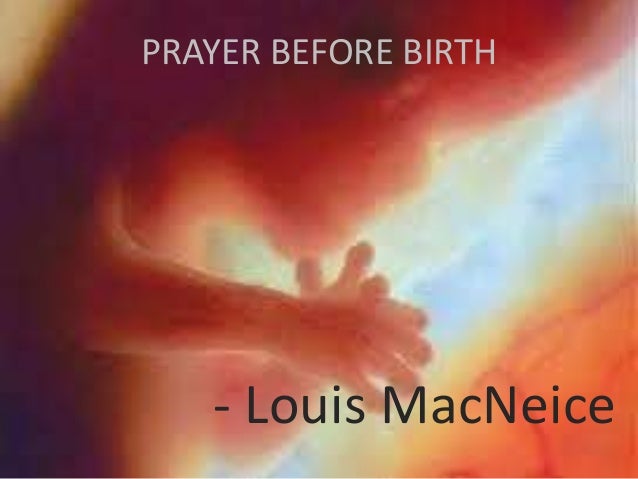
Prayer before birth


                                           Prayer bebore birth


 Image result for prayer before birth louis macneice poem


Introduction:-


The poem “Preyer before birth” was written by Louise macneice . 
Who was an Irish poet and playwright . This poem is written for a
 child who is yet not born . In this poem the poet Loise macneice 
has drawn a picture of a corrupt , hateful and devilish world .
 
The child must be in the womb of the child prayers to god . The 
poem in that sense is a prayer of an unborn chiled who is yet to
 come in the world In the very first stanza child argue to God .
Image result for prayer before birth louis macneice poem
I am not yet born : O hear me

In this poem child request to god for manny things like Child says to God that protect him from “ Blood sucking ” , “ To console him ”.and than child tald that provid water of purity , bird and light ,forgiveness , to rehearse him, to fill him Etc...
Let us see that which kind of argue here for example In the last two lines the child argue God that


“ Let then not make me a stone and let them not spill me . Otherwise kill me . ”

If ultimately to survive in the selfish and cruel world , he has to became a like a stone than he to request to God “ to kill him ” not to let him witness selfishness of the world and be part of it rather he would chose to die .


Thus , in the poem “ Preyer before birth” expresses imotion of unborn child who is worried regarding his present and future who does not want to corrupt his soul and does not want anyone else .


"La Belle Dame sans Merci"


                                                                       Poem


Image result for la bella demes sens marcy
O what can ail thee, knight-at-arms,Alone and palely loitering?The sedge has withered from the lake,And no birds sing.
O what can ail thee, knight-at-arms,
So haggard and so woe-begone?
The squirrel’s granary is full,
And the harvest’s done.

I see a lily on thy brow,
With anguish moist and fever-dew,
And on thy cheeks a fading rose
Fast withereth too.

I met a lady in the meads,
Full beautiful, a fairy’s child;
Her hair was long, her foot was light,
And her eyes were wild.

I made a garland for her head,
And bracelets too, and fragrant zone;
She looked at me as she did love,
And made sweet moan

I set her on my pacing steed,
And nothing else saw all day long,
For sidelong would she bend, and sing
A faery’s song.

She found me roots of relish sweet,
And honey wild, and manna-dew,
And sure in language strange she said—
‘I love thee true’.

She took me to her Elfin grot,
And there she wept and sighed full sore,
And there I shut her wild, wild eyes
With kisses four.

And there she lullèd me asleep,
And there I dreamed—Ah! woe betide!—
The latest dream I ever dreamt
On the cold hill side.

I saw pale kings and princes too,
Pale warriors, death-pale were they all;
They cried—‘La Belle Dame sans Merci
Hath thee in thrall!’

I saw their starved lips in the gloam,
With horrid warning gapèd wide,
And I awoke and found me here,
On the cold hill’s side.

And this is why I sojourn here,
Alone and palely loitering,
Though the sedge is withered from the lake,
And no birds sing.


                               Summery 


 "La Belle Dame sans Merci"  is a ballad  written by the English poet .John Keats It exists in two versions, with minor differences between them. The original was written by Keats in 1819. He used the title of the 15th-century La Belle Dame sans Mercy by Alain Chartier, though the plots of the two poems are different.[2]
The poem is considered an English classic, typical of other of Keats' works. It avoids simplicity of interpretation despite simplicity of structure. At only a short twelve stanzas, of only four lines each, with a simple ABCB rhyme scheme, the poem is nonetheless full of enigmas, and has been the subject of numerous interpretations.

"La Belle Dame sans Merci" is a popular form given an artistic by the Romantic poets. Keats uses a stanza of three iambic tetrameter lines with the fourth dimetric line which makes the stanza seem a self-contained unit, giving the ballad a deliberate and slow movement, and is pleasing to the ear. . Keats's economical manner of telling a story in "La Belle Dame sans Merci" is the direct opposite of his lavish manner in "The Eve of St. Agnes". Part of the fascination exerted by the poem comes from Keats' use of understatement.

Keats sets his simple story of love and death in a bleak wintry landscape that is appropriate to it: "The sedge has wither'd from the lake / And no birds sing!" The repetition of these two lines, with minor variations, as the concluding lines of the poem emphasizes the fate of the unfortunate knight and neatly encloses the poem in a frame by bringing it back to its beginning. Keats relates the condition of the trees and surroundings with condition of the knight who is also broken.

In keeping with the ballad tradition, Keats does not identify his questioner, or the knight, or the destructively beautiful lady. What Keats does not include in his poem contributes as much to it in arousing the reader's imagination as what he puts into it. La belle dame sans merci, the beautiful lady without pity, is a femme fatale, a Circe-like figure who attracts lovers only to destroy them by her supernatural powers. She destroys because it is her nature to destroy. Keats could have found patterns for his "faery's child" in folk mythology, classical literature, Renaissance poetry, or the medieval ballad. With a few skillful touches, he creates a woman who is at once beautiful, erotically attractive, fascinating, and deadly.